AI for business
Raising Kids Who Think, Not Just Click, in the AI Age
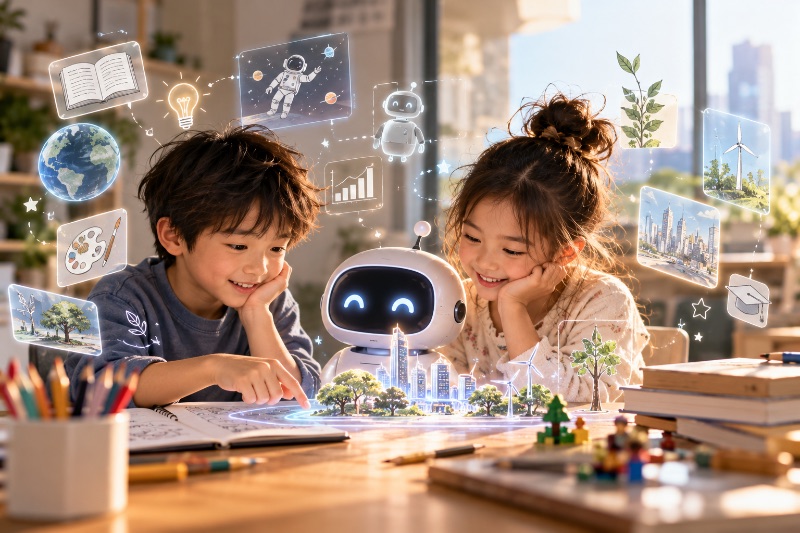
As a parent who works with AI, I find myself thinking about what my children will need in a world where technology can already do so much.
I want them to understand technology. But more importantly, I want them to be able to question it, challenge it and think independently of it.
When a child shows interest in technology, it's natural to point them towards whatever skill seems most valuable at the moment. These days, that often means coding.
But I keep coming back to a harder question.
Which skills will actually last, and which ones might be reshaped by AI before today's children even begin their careers?
When AI Can Already Do the Work
AI tools can already write working code, summarise complicated information and generate first drafts in seconds.
That doesn't make technical skills worthless.
But it does change what we should pay attention to.
When technology makes producing an answer easier, knowing what to ask and whether the answer is any good becomes increasingly important.
I think of these as two connected skills.
Clarity: Being able to understand a problem and explain it well enough that another person, or an AI tool, can help solve it.
Judgment: Having enough understanding to recognise when an answer is useful, incomplete or simply wrong.
Neither is new. They're part of what we've always called good thinking.
AI just makes them more important because it can produce an incorrect answer that sounds remarkably convincing.
Learning to Think, Not Just Follow Instructions
This connects with how the OECD describes the future of education in its Learning Compass 2030.
The framework emphasises student agency, the ability to navigate unfamiliar situations and competencies that go beyond technical knowledge alone.
It's a vision for education rather than a prescribed curriculum, but the underlying idea resonates with me.
Children need more than the ability to follow instructions or operate the latest tools.
They need opportunities to ask questions, make decisions, solve problems and learn from mistakes.
The tools they use will change.
Their ability to think through unfamiliar situations is something worth developing throughout their lives.
Does This Mean Children Shouldn't Learn Coding?
Not at all.
I still believe there's value in children understanding how technology works.
Learning to code, use spreadsheets or explore AI can help them develop logical thinking, recognise patterns and understand how digital systems behave.
Even if AI eventually handles more of the technical work, having that foundation can help someone ask better questions and evaluate the results.
But I don't think coding should be treated as the only path to preparing children for the future.
A child who can write code but struggles to explain what they're trying to build may find technology frustrating.
A child who can ask thoughtful questions, experiment and recognise mistakes has skills that apply far beyond programming.
The goal isn't just to teach children how to use technology. It's to help them understand what they're doing with it.
What This Looks Like at Home
I don't think preparing children for an AI-shaped future requires a complicated curriculum.
Sometimes, it starts with small conversations.
Imagine a child using AI to help with a school project.
Instead of simply accepting the answer, we could ask:
- Why do you think that's correct?
- How would you check it?
- Can you explain it in your own words?
- What would you do differently?
Or imagine a child learning to code.
The goal doesn't always have to be writing every line perfectly or finishing the project as quickly as possible.
Understanding why something works, spotting mistakes and trying different approaches can be just as valuable.
The same applies outside technology.
Building something with LEGO, drawing without a fixed plan, solving a puzzle or figuring out why an experiment didn't work all create opportunities to think independently.
Of course, children also need guidance. Sometimes showing them how to do something is exactly what helps them learn.
It's about finding a balance between helping them and giving them space to figure things out.
The aim isn't to keep children away from AI. It's to help them become confident enough to use it without depending on it for every answer.
Curiosity Matters More Than Getting Everything Right
One thing I hope my children keep as they grow older is their curiosity.
The willingness to ask why.
To try something without knowing whether it will work.
To change their minds when they discover something new.
And to be comfortable admitting they don't know the answer yet.
AI makes it easier than ever to get an immediate response to almost any question.
But getting an answer isn't the same as understanding it.
Sometimes the most valuable part of learning is the process of working something out.
I don't want my children to feel they always need the fastest answer.
I want them to enjoy discovering things for themselves.
The Same Skills Matter for Adults
Interestingly, the more I work with AI, the more I see these same principles applying to adults.
AI can draft an email, write code, organise information or suggest a solution.
But someone still needs to understand the problem, decide what a good result looks like and recognise when something isn't right.
At Runoan, we spend time exploring how AI and digital tools can help businesses work better.
And one thing I've learned is that technology becomes much more useful when the person using it knows what they're trying to achieve.
The ability to communicate clearly, question assumptions and exercise judgment matters whether you're a business owner, a developer, a designer or a child learning something new.
Preparing Children for a Future We Can't Predict
I don't know exactly what jobs will exist when today's children grow up.
Some skills will become more valuable. Others will change, and new ones will emerge.
As AI becomes better at producing answers quickly, children may increasingly be valued for their ability to ask meaningful questions, evaluate information and apply what they know.
We can't prepare them for every technology they'll encounter.
But we can help them develop the confidence to learn, adapt and think for themselves.
As someone who builds with AI, I'm excited about what technology makes possible.
As a parent, I'm equally interested in what we should continue developing in ourselves.
Curiosity. Clarity. Judgment. The confidence to question, experiment and find our own way.
Those are things worth nurturing, whatever the future brings.