AI for business
Does Your Business Need an AI Agent? Four Options to Try
AI agents are everywhere in conversations about business technology. They are described as tools that answer enquiries, manage workflows and prepare reports.
Before spending time or money on one, it helps to ask a plainer question: what problem are you trying to solve?
For many small and medium-sized businesses, the answer may not be an agent at all. A clearer process, a better form or a simple automation can sometimes do the job.
What Is an AI Agent?
Anthropic, an AI company, distinguishes between two kinds of systems in its guide, Building Effective Agents.
In a workflow, AI and its tools follow steps defined in advance. In an agentic system, AI can choose which steps to take and which permitted tools to use within defined boundaries.
That doesn't mean an agent operates without rules, supervision or limits.
Anthropic's advice is to find the simplest solution that works and add complexity only when it's needed.
In everyday terms, here's how the three approaches differ.
Simple Automation
What it does: Follows fixed rules.
Business example: Automatically sends an acknowledgement when a customer submits an enquiry form.
AI Assistant
What it does: Helps a person complete a task.
Business example: Drafts an email, summarises a document or helps prepare a customer response.
AI Agent
What it does: Chooses steps and uses permitted tools to complete a task.
Business example: Reads a customer enquiry, checks information against approved business rules and prepares a draft quotation for approval.
The more freedom a system has, the more you need to think about permissions, reliability, cost and who checks the result.
An Example: Made-to-Order Enquiries
Imagine a small business that makes products to order.
Customers send measurements, photos, material preferences and delivery details. Some leave out important information.
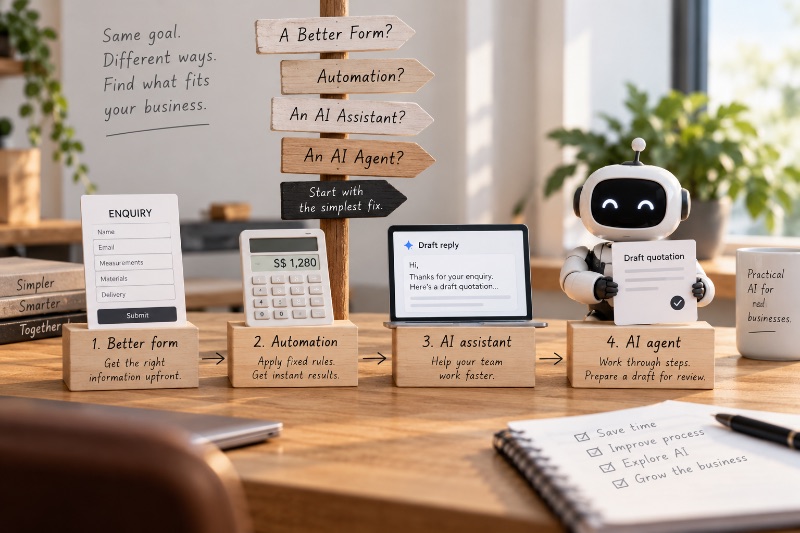
Here are four ways to improve the process, from simplest to most advanced.
Option 1: Improve the enquiry form.
Add fields for the details you always need. Customers provide more complete information, so there are fewer follow-up messages.
No AI needed.
Option 2: Use a rules-based estimator.
Customers enter measurements and choose from available options. Fixed rules calculate an indicative price.
Where exact calculations matter, conventional software should handle the arithmetic.
Again, no AI needed.
Option 3: Add an AI assistant.
Someone in your business uses AI to summarise enquiries, identify missing details and draft replies.
A person stays in control.
Option 4: Try an AI agent.
An agent reads an enquiry, checks the information against approved business rules and prepares a draft response or quotation.
A person reviews and approves it before anything is sent.
Each option suits a different level of complexity.
Sometimes, the first two deliver most of the benefit.
You don't need to start with the most advanced solution. You need to start with the one that makes sense.
Five Questions to Ask Before Building an AI Agent
- What task takes up too much time? Write it down and note how often it happens. A task that takes five minutes once a month rarely justifies an agent. One that several people repeat daily might.
- Is the process already clear? If everyone does it differently, an agent may simply reproduce the confusion. Write down the steps, the information needed and what a correct result looks like. This sometimes reveals improvements that need no AI.
- Does the task need interpretation? Fixed steps suit ordinary automation. Varied inputs, such as enquiries in different formats, are where AI becomes more interesting.
- Can you trust the information it uses? Outdated prices or unclear rules lead to incorrect results. Decide what information is approved, what actions are allowed and who checks the output.
- Will it really save time? Count setup, testing and checking. If an agent saves two hours but requires three hours of correction, it hasn't helped.
Keep the Risks Small
AI can misunderstand instructions or use incorrect information.
A sensible starting point is to let it prepare work rather than make irreversible decisions.
For example, an agent can draft a quotation without sending it, or organise enquiries without deleting customer records.
Limit its access, protect customer information, keep an approval step and test with realistic examples first.
As the process becomes more reliable, you can decide carefully which low-risk tasks might run automatically.
Automation should earn your trust through testing, not assumptions.
Start Small
Pick one repetitive task.
Understand how it works today.
Improve the process first.
Then decide whether automation, an AI assistant or an agent fits.
Measure the time saved, the accuracy of the results and how much checking is still needed.
For a wider perspective on why AI works best when it expands what people can do rather than simply replacing them, see Erik Ingvoldstad's article “Augment First. Optimise Later.” on Acoustic.sg (26 June 2026).
How We Can Help
At Runoan, we bring together independent specialists to help small and medium-sized businesses build, improve and solve practical business problems.
Our work covers three areas:
- BUILD: Websites, applications, calculators, digital tools and practical automation.
- IMPROVE: Existing websites, workflows and customer enquiry processes.
- SOLVE: Business challenges, discovery and practical AI implementation.
Sometimes the answer is a custom digital tool. Sometimes it's automation or AI. And sometimes, it's simply improving what you already have.
We start by understanding what's not working, then explore the simplest useful solution.
If you're wondering whether your business needs an AI agent, a simpler fix or neither, let's talk.
The first conversation is free.
Email hi@runoan.com or WhatsApp us at +65 8946 3370.