AI for business
AI Agents vs Skills: A Simple Kitchen Analogy
You've probably heard the term "AI agent" and wondered what it actually means for a business like yours.
And now there's another term floating around: "AI skills."
Are they the same thing? Do you need both? And where would you even start?
Here's a simple way to understand them, using something familiar: a kitchen.
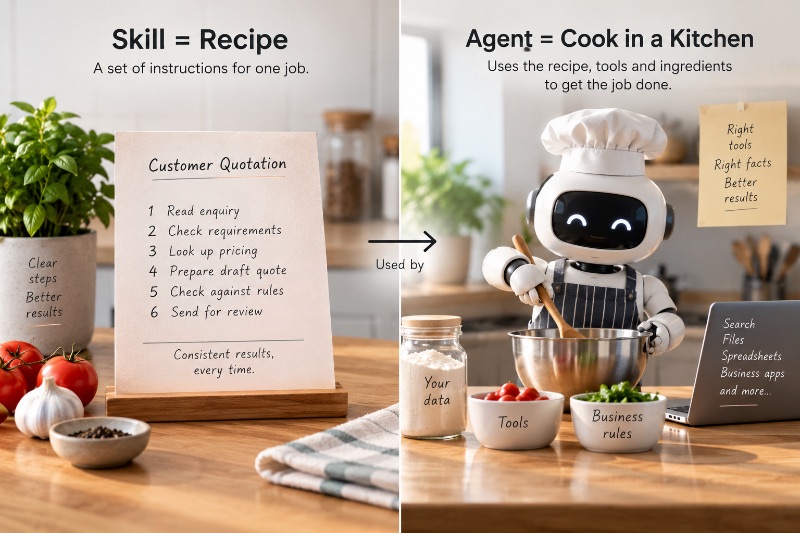
A Skill Is a Recipe
Think of a skill as a recipe.
It's a set of instructions for doing a particular job.
In a business, that might mean:
- How to prepare a customer quotation.
- How to respond to an enquiry.
- How to check a document before sending it.
- How to organise information into a report.
A recipe explains the steps, the rules and what a good result should look like.
But a recipe doesn't cook dinner.
Someone, or something, needs to follow it.
That's where an agent comes in.
An Agent Is the Cook
Imagine a cook working in a kitchen.
The kitchen has equipment: an oven, a stove, knives and utensils.
It also has ingredients.
The cook brings everything together, follows instructions, makes decisions and works towards a finished dish.
An AI agent works in a similar way.
Its kitchen might contain tools such as search, spreadsheets, files or business software. Its ingredients are the information and rules it has permission to use.
The agent can decide which steps to take, use available tools and work towards completing a task.
But there's an important distinction.
An agent doesn't automatically have access to your business information or systems. Those tools and permissions must be provided.
And just like a cook, an agent needs clear instructions and reliable ingredients to produce a useful result.
How Skills and Agents Work Together
The recipe tells you how to prepare a dish.
The cook carries out the work.
An agent can use a skill when a task calls for it.
For example, one agent might have several skills: preparing quotations, organising enquiries and checking documents.
The same skill could also be used by different agents.
Not every agent needs a separate skill. Some tasks can be handled through direct instructions.
But when a business repeats the same job regularly, a reusable skill can help make the process more consistent.
The skill explains how. The agent carries out the work.
An Example: Preparing a Customer Quotation
Imagine you run a small business that receives customer enquiries every day.
A customer emails asking for a quotation.
Normally, someone has to read the enquiry, check the requirements, look up pricing, prepare a response and send it back.
Here's how an agent and a skill could help.
The recipe (skill):
Your business has written instructions explaining how quotations should be prepared, which pricing rules apply and what information must be confirmed.
The ingredients (information):
Your approved price list, product specifications, delivery charges and the customer's requirements.
The cook (agent):
The agent reads the enquiry, identifies missing information, uses the approved rules and prepares a draft quotation.
The person tasting the dish (you):
You check the quotation, confirm the details and approve it before it reaches the customer.
Instead of preparing everything from scratch, you're reviewing work that's already been organised.
The goal isn't necessarily to remove people from the process.
It's to reduce repetitive work so people can spend more time on decisions that matter.
What Can Go Wrong?
A good cook still needs good ingredients.
If your agent uses outdated prices, incorrect specifications or incomplete customer information, the result can be wrong, however confidently it's presented.
And without clear instructions, an agent may improvise when consistency matters.
That's why businesses need more than an AI tool.
They need reliable information, clear rules, appropriate permissions and someone responsible for checking the results.
For important business processes, the quality of the information and instructions matters just as much as the technology.
Who Tastes the Dish?
At the beginning, you do.
If you're introducing AI into your business, start by having a person check customer-facing messages, quotations and important decisions before anything is sent or acted upon.
This is especially important when the work involves pricing, contracts, personal information or legal obligations.
As the process becomes more reliable, you can carefully decide which low-risk tasks might run automatically.
Not everything needs human approval forever.
But automation should earn your trust through testing, not assumptions.
Where Should a Small Business Start?
You don't need to build a complicated AI system to begin.
Start with one job you repeat every week.
It might be preparing quotations, organising enquiries, drafting routine emails or checking documents.
Write down how you currently do it.
That's your recipe.
Identify the information needed to complete the task.
Those are your ingredients.
Decide which tools are required and who will check the result.
Then try it on a small scale.
You may discover that a simple automated workflow is enough. You may find that an AI assistant works better. Or you may have a task that genuinely benefits from an agent.
Start with the problem, not the technology.
The Takeaway
A skill is a recipe. An agent is the cook.
The tools and information are the kitchen and ingredients.
And the business owner decides what makes a good dish.
You don't need to understand every technical detail to start exploring AI.
You just need to understand what you're trying to improve, what information the system needs and how you'll know whether it's working.
At Runoan, we help small businesses explore practical AI, automation and digital tools without unnecessary complexity.
If you're wondering where AI might fit into your business, let's talk it through.
The first conversation is free.
Contact us at hi@runoan.com.